ພາສາຈິນ (07/01/2013) — Deputy Prime Minister Somsavat Lengsavad has urged the Lao-Indochina Group (LIG) Public Company’s tapioca factory to build a small power plant to generate electricity, using its abundant source of biogas.
“Then I will ask Electricite du Laos to come and see the plant and sign a power purchase agreement with company,” Mr Somsavat said when visiting t he tapioca factory in Pakngum district, Vientiane, recently.
Mr Somsavat advised the tapioca producer to build the power plant because he foresees that there will still be a large surplus of biogas beyond what is required for tapioca production.
The Chairman of the Board of Directors , Mr Sengmaly Sengvatthana, said “The excess biogas can be used to generate electricity from a power plant that has an installed capacity of about 1 megawatt.”
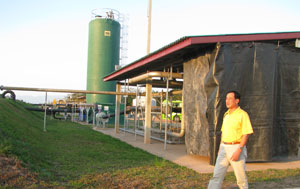
Mr Sengmaly said that construction of the biogas plant is now complete and they will conduct a trial run using biogas in the tapioca factory this month.
LIG has cooperated with Thai Biogas Energy Co Ltd who made an initial investment of about 33.8 billion kip (US$4 million) in the biogas plant and will operate it for 15 years, after which time ownership will revert to LIG . Gas produced by the plant will be sold only to the group’s tapioca factory.
The biogas plant will have a gas production capacity of about 2 million cubic metres per year, according to a report from LIG.
Once the biogas plant starts to supply the tapioca factory, there will be a considerable surplus of the gas as production will be larger than the demand of the tapioca plant.
“Once a small power plant is built, the company can sell the electricity generated to the district at a cheaper price than normal if possible,” Mr Somsavat said. “This will be especially helpful to the district administration office, hospital and the police and army administration offices.”
“T his is to help the district in its development. It will also help reduce the district’s expenditure on energy and they will able to use the excess budget for other developments,” Mr Somsavat said.
Mr Sengmaly said the use of biogas will create a stable heat for tapioca production and will also help to improve the quality of the powder. Using coal, the heat produced is not stable; sometimes insufficient heat is produced, which affects the quality of the end product.
For example, if the factory wants an output of 100 tonnes of tapioca it may only get 80 tonnes because of the unstable heat obtained from burning coal. So it will soon stop using coal, as it consumes many tonnes each year.
The use of charcoal also causes pollution and its price fluctuates too wildly. The biogas is smoke free so it has no negative impact on the environment.
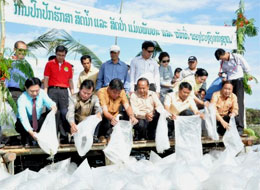
The company will use the wastewater from tapioca production as a source for biogas production. Then it will use the treated water to farm fish in the future.
Vientiane Times